GIVEN THE REALITY OF GLOBAL WARMING, WHOSE CONSEQUENCES ARE VISIBLE ALL OVER THE PLANET, WHAT RESPONSE IS BEING GIVEN TO MITIGATE ITS CAUSES?
- Floods, droughts, and storms have become 15 times more intense in the last 10 years (IPCC AR6 report).
- According to the “World Energy Outlook 2024,” maintaining current policies could result in a global temperature rise of 2.4°C by the end of the century.
In 2015, under the Paris Agreement, countries committed to reducing emissions to limit global warming to below 2°C, with the desired target being 1.5°C above pre-industrial levels.
SECTORS IN WHICH COUNTRIES ARE INTERVENING TO ACHIEVE THIS GOAL:
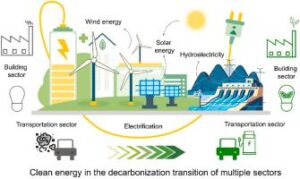
- 1. Renewable energy and decarbonization in the electricity sector. According to an IEA report, the production of clean energy, combined with decarbonization, is one of the most impactful measures in reducing greenhouse gases.
Renewable energy production is expanding. Decarbonization is being compromised by the reopening of coal-fired power plants, which had already been closed due to Russia’s war in Ukraine.
- Digital technologies applied to various sectors, including industrial processes, mobility, and buildings, optimize processes and reduce emissions.
In buildings, through better insulation and ventilation, and more efficient heating/cooling systems.
In vehicles, by replacing combustion engines with electric ones, a growing sector.
In mobility, public transportation is becoming more efficient.
- Carbon capture. CO2 removal.
Heavy industries such as cement, steel, and chemicals are beginning to use technology to capture, utilize, and store carbon. One example is Norway, with an industrial project aiming to capture millions of tons per year.
- Direct Air Capture (DCA). Enhanced Rock Weathering Biochar (ROB) has begun to advance this technology, albeit on a modest and costly scale. This technology consists of pulverizing rocks, such as basalt, and spreading the powder over agricultural areas, beaches, and oceans to increase the exposed surface area and accelerate the reaction with atmospheric CO2, permanently transforming it into carbonates and bicarbonates.
- Maritime transport is establishing global regulations for ship emissions.
- Some countries and cities are beginning to implement strict building codes with energy efficiency standards, heatwave adaptation plans, and urban green infrastructure.
- Reduction of CH4 emissions in gas and oil production, using best industrial practices, considering that the CH4 molecule has a greater heat retention potential than the CO2 molecule.
LIMITATIONS
However, there is a gap between the targets required to keep the temperature rise below 1.5°C and concrete actions.
We still have many countries that are completely dependent on fossil fuels, industry, energy production, and transportation.
The application of clean technologies and carbon removal faces financial, infrastructure, and even regulatory limitations.
Even worse is the political and economic inertia, clearly visible in fossil-dependent industries, which act as lobbyists for public policy decision-makers.
This is an important aspect in which global pressure from citizens must be felt and their voices heard.
Another limitation is that countries with fewer resources lack the capacity to transition to clean energy, requiring technology and financial support.
Some actions, such as those currently being implemented, have a positive effect, but according to recent estimates, the pressing need to achieve only a 1.5°C increase in average temperature is increasingly unlikely due to uncertainty in international geopolitics (ongoing wars), large-scale forest fires, deforestation, delays in implementing the measures adopted at COP 28 and 29, and the fossil fuel sector’s lobbying.
Various reports agree that even with larger emissions cuts, if CO2 removal through natural means, soils and forests, or technological means, is not included, it will be impossible to limit global warming.
There is an even greater problem: the future climate will affect renewable energy production, such as sunlight, droughts, changes in wind patterns, and river discharges.
It is known that isolated policies have less impact than comprehensive policies such as carbon taxes, renewable energy subsidies, increased tax incentives, and public education, which have more positive results. There are countless studies and climate models that establish the relationship between certain practices and the reduction of CO2 and the impact on temperature.
One example is “Earth System Models” regarding agricultural practices, which established that a reduction of 5-19 ppm of CO2 reduces temperatures by between 0.02°C and 0.10°C by the end of the century.
The relationship between cumulative CO2 emissions and the global average temperature over decades is already well known.
The “Transient Climate Response to Cumulative CO2 Emissions (TCRE) study” provided various data.
Data from IPCC AR6, based on studies, established the relationship:
Every 1000 Gt of cumulative CO2 causes 0.27°C to 0.63°C of warming, with an average value of 0.45°C. This assessment does not consider CH4, N2O, and aerosol emissions. If they are included, the probability could reach 1.5 to 2°C.
Many other papers and publications have been produced, such as “The Proportionality of Global Warming to Cumulative Carbon Emissions”; “Global Carbon Budget” and many others are unanimous in demonstrating the almost linear proportionality between cumulative carbon and global warming.
According to the IPCC AR6 report, by 2024, we will be emitting between 40 and 43 Gt of CO2 annually. If we contain 100 Gt of CO2, this corresponds to an emissions saving of 2.5 years, delaying warming by 0.045°C.
“The Rogelj” report tells us that we can emit only 130 Gt of CO2 from 2025 onwards, for a thermal temperature contained at 1.5°C.
A thorough analysis of this data alone is enough to make us apprehensive and realize the extent of the global world’s delay in meeting achievable targets!
At the current pace, the 1.5°C target will no longer be possible, and this should put us on a” war footing”.
There is much more to do, and more quickly!
Our action is necessary!
Our struggle is important!
Inertia cannot be allowed!
LET’S BRING THE TRUTH TO THE PUBLIC!
LET’S EXPOSE THE DEFENDANTS AND THE LOBBY!
LET’S PUT PRESSURE ON THE DECISION-MAKERS!
References:
IPCC AR6
https://www.ipcc.ch/assessments-report/ar6/
World Energy Outlook 2024
https://iea.blob.core.windows.net
IEA (International Energy Agency) 2024 Report
https://www.iea.org
Study “Effectiveness of Agricultural Carbon Dioxide Removal” (Evans and Mathews, 2025)
https://egusphere.copernicus.org
Global Carbon Budget (Friedlingstein et al., Annual Updates, 2020/2025)
https://www.globalcarbonbudget.org
Rogelj et al. – Indicators// Remaining, carbon budget updates (Earth system Science data, 2024-2025)
https://essd.copernicus.org
Gabriela Delgado
- COP30 Brasil Bulletin #32 – Pre-COP Sets COP30’s Mission: From Planning to Action
- ONU alerta para alta nas emissões e déficit bilionário no financiamento climático antes da COP30
- MANIFEST